 Nainital is a town in the Indian State of Uttarakhand and headquarters of Nainital District in the Kumaoon Foothills of the outer Himalays. Situated at an altitude of 1,938 meters (6,358 feet) above sea level, Nainital is set in a valley containing a pear-shaped lake, approximately two miles in circumference, and surrounded by mountains, of which the highest are Naina (2,615 m (8,579 ft)) on the north, Deopatha (2,438 m (7,999 ft)) on the west, and Ayarpatha (2,278 m (7,474 ft)) on the south.
 Kathgodam 35 Kms. away is the last terminus of broad gauze line of North East Railways connecting Nainital with Delhi,Dehradun & Howarah .
We have taken Ranikhet express which departs from Old Delhi railway station at 10:45 PM daily , it reaches Kathgodam at 6:05 AM . At the time of return we have taken Uttaranchal Sampark Kranti Express , it start from Kathgodam at 8:50 AM in the morning and reaches Delhi at 3:20 PM and on the same day return from Delhi at 4:00 PM and reaches Kathgodam at 10:45 PM. Normal fare from Kathgodam to Nainital via bus is around Rs. 40 and via shared taxi is around RS. 60--80.
Places We Have Visited:
Lake :
 The nucleus of Nainital’s exquisite beauty is beautiful lake .In the day ,mirrored in its waters stand seven proud hills,dotted with pretty cottages and villas . This reflection alone holds one spell bound. More beautiful than this however is the lake at night when the myriads of bulbs from the hill sides and quite a large number hanging near the lake’s edge stab their magic light into its waters.
The lake offers the holiday makers ample opportunity for yachting, boating or paddling the boat. Boating rates in conventional rowing boats ranges from Rs. 30/- to Rs. 50/- in peak season days from one end of lake to another end. Paddling boats are available on hourly rate from Rs. 50/- to Rs. 90/- depending on type of paddle boat and tourist rush. Rowing as well as paddling boats are available at both ends of lake.
Snow View :
 It is the most easily accessible hill top, height 2270 mts. and at a distance of 2.5 Km from the town. The spot is accessible through ropeway . This peak is also connected by motor able road.
Naina Peak or China Peak:
 Naina peak is the highest peak of the town , at an altitude of 2611 mts. and at a distance of 6 Kms from the town .It commands an entrancing view of sparkling snow laden Himalayas from Bandar Punch in west to Api and Nari peaks of Nepal in the east , a full Himalayan range in one side and a birds eye view of the lake city of Nainital in its full grandeur on the other.
Horse Riding And Lands End:
 Horse riding is another important attraction for tourists in Nainital . Horses can be hired at Barapatthar . Several tourist use horses as their transport mode to visit the different peaks of Nainital. Hiring Horse @ 400 Rs per head for 2-3 hours we have visited several other places like Lands End (Picture Given Below), inside Jim Corbett National Park, Dorothy Seat & Tiffin Top etc. etc and its really paisa vasool...
 Lovers Point and Suiside Point:
Hope no explanation needed!!!
 Kilbury :
At an altitude of 2194 mts. and 10 Kms. from the town this place is accessible by a motor able road. There is a forest rest house for night stay.Kilbury is an ideal spot for a quiet and peaceful holiday.
 Caves Garden :
This feature is the latest addition in the list of numerous tourism spots in Nainital . It is located in Sukha Tal around one Km from Mallital very near to Kumaun University Campus.
Hanuman Garhi :
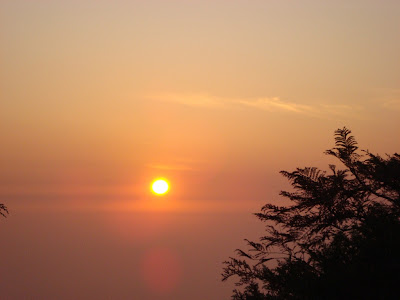
It is around 3.5 Kms away from the bus stop at an altitude of 1951 Mts. Hanuman Garhi is a religious centre and famous for its sun set view .One can go to Hanuman Garhi by taxi, bus or even on foot from Nainital .It has a temple complex presiding deity being Lord Hanuman besides Ram and Shiva. At the instance of Neem Karoli Baba around 1950 these temples were built. On the other side of the hill there is Shitala Devi temple and Ashram of Lila Sah Bapu.
The Mall :
 On one of side of lake run the Mall road now named Govind Ballabh Pant Marg. It is lined up by many hotels ,reataurents,travel agencies , shops ,banks and other business concerns. In summer months of May & June Mall road is closed for vehicular traffic in evening hours to facilitate Mall strolling which is the famous attraction for all the tourists. This road is the main link joining Mallital and Tallital.
On the other side of the lake lies the Thandi Road . It is comparatively less busy and have Pashan devi temple. Vehicles are not allowed on Thandi Road .
Governor’s House (Raj Bhavan) :

Raj Bhavan was built by British as residence of Governor of North West Province. Now Raj Bhavan is the official accommodation of Governor (Uttaranchal).State guests coming to Nainital also use it for their stay. It consists of a marvelous garden, Golf Links, Swimming Pool.Jhandidhar Modi Heights,Munshi heights are the other places in the complex worth seeing .The Governor’s House was built in the line of Buckingham Palace having double storied 113 rooms .For visiting this place prior permission is must.
Mini Golf:
 Near bus stand, inside a hotel this miniature 9 whole golf course is available... its pure time pass in the back drop of Nainital...
After covering all these we went to Ranikhet... (To be continued...)


